Introduction
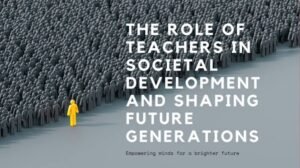
Teachers are among the most important people in every society because they play a significant role in shaping the minds, characters, attitudes, and destinies of individuals. They are the foundation upon which the future of every nation is built. While doctors save lives, engineers construct buildings and bridges, lawyers defend justice, and leaders govern nations, teachers are the people who educate and prepare all these professionals for their responsibilities. Behind almost every successful individual is a teacher who, at one point in life, provided guidance, encouragement, knowledge, and inspiration.
The importance of teachers cannot be measured by the number of lessons they deliver, the subjects they teach, or the certificates their students obtain. Their influence goes far beyond the classroom. Teachers are builders of knowledge, developers of talents, promoters of moral values, mentors of young people, and agents of positive social transformation. They do not merely teach students what to know; they help them understand how to think, how to make decisions, how to overcome challenges, and how to become responsible members of society.
The future of any nation depends greatly on the quality of education its citizens receive, and the quality of education is strongly influenced by the commitment, competence, and dedication of its teachers. A nation may possess abundant natural resources, modern infrastructure, and enormous economic opportunities, but without knowledgeable, skilled, and responsible people to manage those resources, meaningful development becomes difficult to achieve. This is why teachers occupy a special position in society.
In today’s rapidly changing world, where technology, science, communication, and social values continue to evolve, the role of teachers has become even more important. They must prepare students not only for the challenges of today but also for opportunities and uncertainties that future generations will encounter. Therefore, teachers should be recognised not merely as employees in educational institutions but as nation-builders whose influence extends across generations.
1. Teachers Are the Foundation of Quality Education
One of the most important roles of teachers is providing quality education and helping students acquire the knowledge and skills they need to succeed in life. Education is one of the strongest foundations of human development, but its effectiveness depends significantly on how knowledge is communicated and understood.
Teachers simplify complex ideas, explain difficult concepts, provide practical examples, and guide students through the learning process. They help learners understand subjects such as mathematics, science, literature, history, technology, and other important areas of knowledge.
A good teacher does not simply encourage students to memorise information for examinations. Instead, a good teacher ensures that students understand what they are learning and know how to apply that knowledge in real-life situations.
For example, a science teacher helps students understand the natural world, a mathematics teacher develops logical and analytical thinking, while a language teacher strengthens communication and expression. Each subject contributes to the intellectual development of students and prepares them for different responsibilities in society.
Teachers therefore serve as the foundation of meaningful education because they transform information into understanding and knowledge into practical ability.
2. Teachers Shape the Character and Moral Values of Students
Academic knowledge alone is not enough to prepare individuals for a successful and meaningful life. A society also needs people who possess integrity, honesty, discipline, respect, kindness, humility, and a strong sense of responsibility.
Teachers play an important role in developing these values among students. Through their words, actions, attitudes, and relationships with learners, they demonstrate the importance of good character.
Students spend a considerable amount of time in educational institutions, making teachers important influences in their social and moral development. A teacher who demonstrates honesty teaches students the value of truthfulness. A teacher who treats everyone fairly demonstrates the importance of equality and justice. A teacher who shows patience encourages students to become understanding and tolerant.
Teachers also help students recognise the consequences of negative behaviours such as bullying, dishonesty, examination malpractice, discrimination, disrespect, and violence.
The influence of a teacher’s character can sometimes remain with a student for an entire lifetime. This is why teachers must understand that their responsibilities extend beyond delivering academic lessons. They are also examples whose conduct can influence the attitudes and decisions of future generations.
A knowledgeable society without moral values may struggle with corruption, injustice, and selfishness. Therefore, teachers must help produce not only intelligent individuals but also responsible human beings.
3. Teachers Discover and Develop Hidden Talents
Every child possesses unique abilities, interests, and potential. However, not every student has the confidence or opportunity to discover these abilities independently. Some students are naturally talented in mathematics, science, writing, public speaking, music, sports, leadership, technology, or creative activities.
Teachers play an important role in identifying these talents and creating opportunities for students to develop them.
A student who struggles academically may possess exceptional artistic or technical abilities. Another student who is quiet in the classroom may have remarkable leadership potential. A teacher who understands individual differences can recognise these abilities and encourage students to develop them.
Through classroom activities, assignments, competitions, practical exercises, debates, research projects, and extracurricular programmes, teachers help students explore their strengths.
They also encourage students who lack confidence to believe in their abilities and work towards improving themselves.
Sometimes, all a young person needs is someone who recognises their potential and tells them that they are capable of achieving something meaningful. A teacher can be that person.
When teachers discover and nurture talents, they help build a generation of innovators, professionals, entrepreneurs, artists, researchers, and leaders who can contribute positively to society.
4. Teachers Prepare Students for Future Leadership
Every nation needs responsible and visionary leaders who can guide society towards progress. However, good leadership does not develop automatically. It requires knowledge, discipline, critical thinking, integrity, confidence, and the ability to make sound decisions.
Teachers help develop these qualities by giving students opportunities to participate in leadership activities and encouraging them to take responsibility.
For example, classroom representatives, student association leaders, debate participants, group coordinators, and prefects learn important leadership lessons through their responsibilities.
Teachers guide students on how to communicate effectively, work with others, resolve disagreements, respect different opinions, and make decisions that benefit the group.
They also teach students that leadership is not about authority, popularity, or personal advantage. True leadership involves service, responsibility, accountability, and commitment to the welfare of others.
A teacher who encourages fairness, discipline, and responsibility contributes to developing future leaders who understand the importance of serving their communities and nations.
The leaders of tomorrow are sitting in classrooms today, and the guidance they receive from their teachers can influence the kind of leadership they provide in the future.
5. Teachers Encourage Critical Thinking and Problem-Solving
The world is constantly changing, and future generations will face challenges that may not have simple or immediate solutions. For this reason, students need more than the ability to memorise facts. They need to develop critical thinking, creativity, reasoning, and problem-solving skills.
Teachers play an essential role in developing these abilities.
Instead of providing answers to every question, effective teachers encourage students to think independently, ask questions, examine evidence, consider different perspectives, and develop their own solutions.
Through classroom discussions, debates, experiments, research activities, and practical assignments, teachers expose students to situations that require intellectual effort and independent reasoning.
For example, a teacher who asks students to investigate the causes of environmental pollution and suggest possible solutions is helping them develop problem-solving skills that can be applied beyond the classroom.
Critical thinking also helps students recognise misinformation, avoid manipulation, and make informed decisions.
In an age where information is easily accessible through the internet and social media, the ability to evaluate information is more important than ever. Teachers must therefore prepare students to become independent thinkers rather than passive receivers of information.
6. Teachers Promote Discipline, Hard Work, and Responsibility
Success in life requires more than intelligence or talent. It also requires discipline, consistency, determination, patience, and a willingness to work hard.
Teachers help students develop these qualities by establishing expectations, encouraging good habits, and guiding them towards responsible behaviour.
Through regular attendance, punctuality, assignments, examinations, classroom participation, and group activities, students learn the importance of commitment and time management.
Teachers also help students understand that failure is not necessarily the end of an opportunity. Instead, failure can become a valuable lesson that encourages improvement and perseverance.
A good teacher does not discourage a student because of poor performance. Rather, such a teacher identifies the areas where the student needs help and provides guidance towards improvement.
This approach teaches students that achievement is often the result of continuous effort rather than instant success.
The discipline students develop in school can become valuable throughout their lives, helping them become responsible workers, business owners, parents, professionals, and citizens.
7. Teachers Promote Social Unity and Peaceful Coexistence
Society consists of people with different ethnic backgrounds, religions, languages, cultures, beliefs, and opinions. These differences can become sources of conflict when people fail to understand and respect one another.
Teachers play an important role in promoting unity, tolerance, mutual respect, and peaceful coexistence among students.
Schools bring together children from different backgrounds and provide opportunities for them to learn, interact, cooperate, and build friendships.
Through civic education, history, social studies, literature, and everyday classroom interactions, teachers help students appreciate diversity and understand the importance of respecting other people’s rights and beliefs.
In a culturally diverse country like Nigeria, teachers have a particularly important responsibility to promote national unity and encourage students to see themselves as members of one nation.
They should teach students that no individual should be discriminated against because of ethnicity, religion, gender, disability, or social background.
When teachers promote understanding and respect among young people, they contribute to building a society where differences are managed peacefully and people can work together towards common goals.
8. Teachers Prepare Students for the World of Work
One of the major responsibilities of teachers is preparing students for future careers and economic participation.
The world of work is becoming increasingly competitive and technologically advanced. Employers and organisations now require individuals who possess not only academic qualifications but also practical skills, communication abilities, creativity, teamwork, and adaptability.
Teachers help students develop these qualities by connecting classroom learning with real-life experiences.
For instance, teachers can introduce practical assignments, business projects, research activities, computer training, vocational exercises, and career guidance programmes.
They can also help students identify their interests and understand the educational and professional pathways required to pursue different careers.
Beyond traditional employment, teachers should encourage students to consider entrepreneurship, innovation, and self-employment.
A teacher who encourages a student to develop a useful skill or explore a business idea may help create an entrepreneur who eventually provides employment opportunities for others.
Education should not only prepare students to search for jobs; it should also prepare them to create opportunities and contribute to economic development.
9. Teachers Promote Technological Advancement and Digital Literacy
Technology has transformed the way people communicate, work, learn, conduct business, and access information. As society continues to embrace digital innovation, teachers must prepare students to participate effectively in the modern technological world.
Teachers help students develop digital literacy by introducing them to computers, educational software, online learning platforms, research tools, and other relevant technologies.
They also teach students how to use digital resources responsibly, evaluate online information, protect their privacy, and avoid harmful online activities.
Modern teachers must understand that technology is not necessarily a replacement for their profession. Instead, it can become a powerful tool for improving teaching and learning.
For example, digital presentations, educational videos, virtual classrooms, online libraries, and interactive learning applications can make lessons more engaging and accessible.
Teachers should also encourage students to explore emerging areas such as artificial intelligence, programming, robotics, data analysis, and digital entrepreneurship.
By promoting technological awareness, teachers help prepare young people for future careers and enable their countries to compete in an increasingly digital global economy.
10. Teachers Build Students’ Confidence and Self-Esteem
Confidence is an important quality that helps individuals pursue opportunities, express ideas, overcome challenges, and achieve personal goals.
However, many students struggle with fear, insecurity, self-doubt, and the belief that they are not intelligent or capable enough to succeed.
Teachers can make a tremendous difference by creating supportive learning environments where every student feels respected, valued, and encouraged.
A teacher who recognises a student’s effort, praises improvement, listens patiently, and provides constructive feedback helps build confidence.
Students should not be made to feel worthless because they learn at different speeds or perform differently in examinations. Instead, teachers should understand that every child has unique abilities and learning needs.
Encouraging students to participate in discussions, make presentations, ask questions, and share their ideas can gradually strengthen their confidence.
Sometimes, a simple statement from a teacher such as “You can do better,” “I believe in your ability,” or “Do not give up” can inspire a student to keep working towards a dream.
A teacher’s encouragement may become the foundation upon which a student’s confidence and future achievements are built.
11. Teachers Contribute to National Development
The development of every nation depends largely on the quality of its human resources. A country requires educated doctors, engineers, scientists, lawyers, entrepreneurs, administrators, researchers, and skilled workers to develop its economy and institutions.
Teachers are responsible for educating and preparing these professionals.
Every profession begins with learning, and learning is guided by teachers. The doctor who saves lives was once a student taught by teachers. The engineer who constructs bridges was once guided by teachers. The scientist who discovers new solutions was once encouraged to ask questions by teachers.
This means that teachers contribute to virtually every sector of national development.
In Nigeria, for example, improving the quality of teachers and educational institutions is essential for addressing challenges such as unemployment, poverty, technological dependence, and inadequate professional skills.
Teachers help develop citizens who can manage resources, solve social problems, strengthen institutions, and contribute to economic growth.
Therefore, investing in teachers is not simply an investment in schools; it is an investment in the future of the entire nation.
12. Teachers Serve as Mentors, Counsellors, and Sources of Inspiration
Not every student has access to the guidance and support needed to navigate life’s challenges. Some students experience family difficulties, financial problems, emotional struggles, peer pressure, and uncertainty about their future.
Teachers often become important sources of encouragement and guidance for such students.
Beyond teaching academic subjects, teachers can listen to students, offer advice, identify difficulties, and direct them towards appropriate support.
They can help students make better decisions about friendships, career choices, personal conduct, and educational goals.
A teacher who takes time to understand a struggling student may discover problems that would otherwise remain unnoticed.
Mentorship is especially important during adolescence, when young people are developing their identities, values, ambitions, and understanding of the world.
A positive mentor can help a student avoid harmful influences, develop healthy habits, and remain committed to personal growth.
The influence of such teachers may continue long after students have graduated from school.
13. Teachers Help Preserve Knowledge and Inspire Lifelong Learning
Education should not end when students leave the classroom or graduate from an institution. The world continues to change, and individuals must remain willing to learn, improve, and adapt.
Teachers introduce students to the value of lifelong learning by encouraging curiosity, reading, research, intellectual exploration, and continuous personal development.
They help learners understand that knowledge is not limited to textbooks or examinations. Valuable lessons can also be gained through experience, observation, research, travel, interaction, and practical activities.
Teachers also preserve and transmit important knowledge from one generation to another. Through subjects such as history, literature, science, mathematics, and cultural studies, they help societies retain their intellectual and cultural heritage.
By developing a love for learning, teachers prepare students to continue acquiring knowledge throughout their lives.
A society that values lifelong learning is better equipped to respond to technological changes, economic challenges, and emerging opportunities.
14. Challenges Facing Teachers in Modern Society
Despite their enormous contributions, teachers face several challenges that can affect their effectiveness and professional satisfaction.
Some of these challenges include:
-
Inadequate salaries and poor working conditions.
-
Insufficient teaching and learning materials.
-
Overcrowded classrooms and excessive workloads.
-
Limited opportunities for professional development.
-
Inadequate access to modern technology.
-
Lack of recognition and respect from some members of society.
-
Poor school infrastructure and learning environments.
-
Increasing pressure from academic expectations and administrative responsibilities.
-
Limited support for students with special educational needs.
-
Insufficient funding of educational institutions.
These challenges are particularly concerning in developing countries where educational systems may struggle with inadequate resources.
It is important to recognise that teachers cannot be expected to deliver excellent educational outcomes when they lack the basic tools, training, motivation, and institutional support required to perform their duties effectively.
Governments and educational authorities must therefore improve teachers’ welfare, provide modern learning facilities, support professional development, and create environments where teachers can perform their responsibilities with dignity.
Teachers deserve more than appreciation during special celebrations. They deserve practical support, fair compensation, professional respect, and opportunities for continuous growth.
15. The Responsibility of Society in Supporting Teachers
The responsibility of shaping the future should not rest on teachers alone. Parents, governments, communities, private organisations, and educational institutions all have important roles to play.
Parents should cooperate with teachers by monitoring their children’s progress, encouraging good behaviour, supporting learning activities, and maintaining communication with schools.
Governments should provide adequate funding, employ qualified teachers, improve educational policies, and ensure that schools have the facilities needed for effective learning.
Educational institutions should encourage innovation, promote academic excellence, and provide teachers with opportunities to improve their professional skills.
Communities should respect the teaching profession and recognise teachers as important contributors to social development.
Students must also appreciate their teachers, take their studies seriously, and understand that the knowledge and guidance they receive can influence their future.
When society supports teachers, teachers are better positioned to support students, and students become better prepared to contribute positively to society.
Conclusion: Teachers Are the Architects of Tomorrow
In conclusion, teachers play an extraordinary role in shaping the future of individuals, communities, and nations. Their responsibilities extend far beyond delivering lessons, marking assignments, preparing students for examinations, and issuing academic instructions. They are builders of knowledge, developers of character, discoverers of talents, mentors of young people, promoters of peace, and architects of national development.
Every successful society needs individuals who are knowledgeable, disciplined, responsible, creative, and committed to making positive contributions. These qualities do not develop by chance. They are nurtured through education, guidance, encouragement, and positive examples, much of which comes from dedicated teachers.
A teacher’s influence may not always be immediately visible. Sometimes, the greatest impact of a teacher is seen years later when a former student becomes a successful doctor, responsible leader, innovative entrepreneur, dedicated professional, or a positive influence in society. Such achievements remind us that teaching is a profession whose rewards often extend beyond the classroom and across generations.
We must never underestimate the power of a teacher. A teacher can change the direction of a child’s life, restore confidence in a struggling student, inspire a generation to dream bigger, and contribute to the transformation of an entire nation. The knowledge shared in a classroom today may become the foundation for discoveries, inventions, leadership decisions, and social improvements tomorrow.
For this reason, teachers must be respected, supported, empowered, and provided with the resources necessary to fulfil their responsibilities. A nation that neglects its teachers risks weakening the foundation of its future, while a nation that invests in its teachers invests in the intellectual, moral, economic, and social development of its people.
If we desire a better future, we must first build better classrooms, empower better teachers, and provide better opportunities for our children. The future of every nation is being shaped in its classrooms today, and the people standing at the centre of that transformation are its teachers.
Let us therefore recognise that teaching is not merely a profession; it is a calling, a responsibility, and a powerful instrument of transformation. Teachers do not simply prepare students for examinations; they prepare them for life. They do not merely transfer knowledge; they inspire wisdom. They do not simply teach the present generation; they help create the future generation.
A teacher’s greatest achievement is not measured by how many students pass through the classroom, but by how many lives are positively transformed through the knowledge, values, discipline, and inspiration they provide.
Ultimately, when we honour teachers, we honour education. When we strengthen teachers, we strengthen society. And when we invest in teachers, we invest in the future of humanity.
The world may celebrate the achievements of great leaders, scientists, doctors, engineers, and innovators, but behind many of these achievements stands a teacher who believed, taught, guided, and inspired. Teachers are the silent builders of civilisation, the shapers of destinies, and the architects of tomorrow.