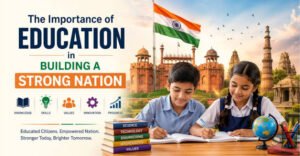
Introduction
Education is one of the most powerful instruments for achieving national development. It is the foundation upon which strong economies, responsible leadership, technological advancement, social stability, and sustainable growth are built. No nation can attain meaningful development without investing in the education of its citizens. Roads, bridges, industries, hospitals, electricity, and other physical infrastructures are important for national progress, but the people who plan, construct, manage, maintain, and improve these infrastructures are products of education. This demonstrates that human capital is one of the greatest resources any nation can possess.
Education goes beyond the four walls of a classroom. It is the process of acquiring knowledge, developing skills, shaping character, promoting values, and preparing individuals to contribute positively to society. It empowers citizens to understand their responsibilities, discover their abilities, solve problems, and participate actively in the development of their country. Through education, individuals become more productive, communities become stronger, institutions become more effective, and nations become better positioned to compete in the global community.
National development is not measured only by the wealth of a country or the number of buildings and industries it possesses. It is also measured by the quality of life of its citizens, the strength of its institutions, the level of literacy, the availability of opportunities, the effectiveness of its leadership, and its ability to provide a better future for coming generations. Education connects all these aspects because it provides the knowledge, skills, creativity, and discipline required to achieve them.
For a developing country like Nigeria, education is particularly important. The country has enormous human and natural resources, but these resources cannot be fully utilised without a knowledgeable, skilled, innovative, and responsible population. Therefore, education must be recognised not merely as a social service but as a strategic investment in national survival, growth, and prosperity.
1. Education Promotes Economic Growth and Development
One of the most significant ways education contributes to national development is through economic growth. A nation’s economy depends largely on the knowledge, skills, creativity, and productivity of its workforce. Educated citizens are better equipped to perform professional duties, establish businesses, manage resources, introduce innovations, and contribute to economic activities.
Education produces skilled workers in different sectors, including agriculture, medicine, engineering, manufacturing, information technology, finance, education, and public administration. These professionals provide the expertise required to develop industries, improve productivity, and strengthen the national economy.
For example, an educated agricultural worker can understand modern farming techniques, improve crop production, manage agricultural resources, and introduce better methods of food preservation. Similarly, educated engineers can design and maintain infrastructure, while trained entrepreneurs can establish businesses that create employment opportunities.
Education also improves people’s ability to make sound financial decisions, manage investments, and develop sustainable businesses. When individuals acquire relevant knowledge and practical skills, they become more productive and economically independent.
A nation that invests in education therefore invests in its economic future. Rather than depending entirely on natural resources, it develops human resources capable of creating wealth, expanding industries, and sustaining economic progress.
2. Education Reduces Poverty and Unemployment
Poverty and unemployment are among the major challenges affecting national development, particularly in developing countries. Education provides an important pathway towards addressing these problems by equipping individuals with the knowledge and practical skills needed to participate in productive economic activities.
When people receive quality education, they have better opportunities to secure employment, become self-employed, establish businesses, and improve their standard of living. Education also helps individuals identify opportunities within their communities and develop solutions that can generate income.
However, modern education should not focus exclusively on producing graduates who depend on government or private organisations for employment. It should also encourage entrepreneurship, creativity, vocational training, technical education, and innovation.
For instance, young people who acquire skills in fashion design, agriculture, software development, electrical installation, catering, construction, and other vocational fields can create employment opportunities for themselves and others.
When education is properly connected to the needs of the economy, it helps reduce unemployment, poverty, dependency, and economic inequality.
A nation cannot achieve sustainable development when a large percentage of its population remains unproductive. Therefore, providing accessible and relevant education is one of the most effective ways of empowering citizens and strengthening the national economy.
3. Education Produces Responsible and Effective Leaders
Leadership plays a vital role in determining the direction and future of every nation. Good leaders require knowledge, wisdom, integrity, critical thinking, and the ability to make decisions that benefit the people they serve. Education helps develop these qualities by exposing individuals to knowledge, different perspectives, ethical principles, and the responsibilities associated with leadership.
Through education, individuals learn about governance, democracy, human rights, accountability, justice, public administration, and national responsibilities. They become better equipped to understand the challenges facing their country and identify practical solutions.
An educated leader should understand that public office is an opportunity to serve the people rather than a means of personal enrichment. Such a leader recognises the importance of transparency, fairness, accountability, and responsible management of public resources.
Education also helps citizens evaluate the performance of their leaders and demand good governance. It encourages people to participate in democratic processes, understand government policies, and make informed decisions during elections.
For Nigeria and other developing nations, education must therefore be seen as an important foundation for producing responsible leaders who are committed to national progress rather than personal interests.
4. Education Promotes Science, Technology, and Innovation
In the modern world, science and technology have become essential drivers of national development. Countries that invest in research, technological advancement, and innovation are better positioned to compete internationally and improve the living conditions of their citizens.
Education provides the foundation for scientific discoveries and technological innovations. Schools, universities, research institutions, and technical colleges equip individuals with the knowledge and skills required to develop new ideas, conduct experiments, solve problems, and create useful technologies.
For example, medical education contributes to the discovery of better treatments and the improvement of healthcare services. Engineering education supports infrastructure development, while information technology education helps countries participate in the digital economy.
Education also prepares young people to understand emerging technologies such as artificial intelligence, robotics, renewable energy, biotechnology, and digital communication.
A nation that fails to invest in scientific and technological education risks becoming dependent on other countries for essential technologies and expertise. Such dependence can limit economic independence and national competitiveness.
Therefore, governments must strengthen science education, support research institutions, provide modern laboratories, and encourage young people to pursue careers in science, technology, engineering, and mathematics.
5. Education Strengthens National Unity and Integration
National development requires unity, cooperation, tolerance, and peaceful coexistence among citizens. A country divided by ethnic, religious, political, or cultural differences may find it difficult to achieve sustainable progress.
Education serves as an important instrument for promoting national unity because it teaches individuals to respect diversity, understand different cultures, appreciate other people’s perspectives, and recognise their shared responsibilities as citizens.
In a diverse country like Nigeria, education can help people understand that despite differences in language, religion, ethnicity, and cultural practices, they belong to one nation and share a common responsibility for its future.
Educational institutions bring students from different backgrounds together, providing opportunities for friendship, cooperation, mutual understanding, and the exchange of ideas.
Through civic education, history, social studies, and other relevant subjects, students can learn about national identity, citizenship, patriotism, peaceful coexistence, and the importance of respecting the rights of others.
When citizens learn to value one another, they are more likely to work together towards common national goals. Education therefore helps build the social harmony necessary for economic growth and national stability.
6. Education Promotes Peace and Reduces Insecurity
Peace and security are essential conditions for national development. No country can achieve sustainable economic growth when its citizens live in constant fear of violence, conflict, criminal activities, and instability.
Education can contribute to national security by addressing some of the social and economic conditions that make individuals vulnerable to criminal activities. It provides people with knowledge, practical skills, positive values, and opportunities to pursue productive lives.
Through education, young people can develop critical thinking, self-discipline, respect for human rights, conflict-resolution skills, and an understanding of the consequences of violence and criminal behaviour.
Education also helps individuals identify misinformation, resist harmful propaganda, and make responsible decisions.
Furthermore, educational opportunities can reduce the vulnerability associated with extreme poverty, exclusion, and unemployment. When young people have access to quality education and meaningful opportunities, they are better positioned to contribute positively to their communities.
Although education alone cannot eliminate insecurity, it remains an important long-term strategy for building a peaceful, responsible, and stable society.
7. Education Improves Healthcare and Public Health
A healthy population is essential for national development. Citizens who enjoy good health are more capable of working, learning, raising families, and contributing productively to society.
Education contributes to improved healthcare by producing qualified medical professionals, including doctors, nurses, pharmacists, laboratory scientists, public health specialists, and medical researchers.
These professionals play important roles in preventing diseases, treating illnesses, conducting research, and improving healthcare delivery.
Beyond professional training, general education helps citizens understand the importance of personal hygiene, proper nutrition, environmental cleanliness, immunisation, sanitation, and disease prevention.
For example, educated communities are better positioned to understand public health information and recognise the importance of safe drinking water, proper waste disposal, and seeking medical attention when necessary.
Education also helps address harmful health practices and misinformation that can threaten people’s lives.
Therefore, investment in education is also an investment in a healthier and more productive nation.
8. Education Promotes Agricultural Development and Food Security
Agriculture remains an important sector in many developing countries, including Nigeria. It provides food, employment, raw materials for industries, and income for millions of people.
However, agricultural development requires more than traditional farming methods. It requires scientific knowledge, modern technology, research, effective management, and access to relevant information.
Education helps farmers understand improved farming techniques, soil management, irrigation, pest control, animal husbandry, food processing, and modern agricultural equipment.
Agricultural institutions and research centres also train specialists who develop improved crop varieties, study environmental conditions, and introduce innovative methods of increasing food production.
Educated farmers are better positioned to understand market demands, manage their finances, reduce post-harvest losses, and improve the quality of agricultural products.
By strengthening agricultural education, a nation can improve food security, reduce dependence on imported food, create employment, and increase its contribution to economic growth.
A country that educates its agricultural workforce is better prepared to feed its population and develop a sustainable agricultural economy.
9. Education Encourages Industrialisation and Infrastructural Development
Industrialisation is an important indicator of national economic progress. A developed industrial sector creates employment, increases production, improves trade, and reduces excessive dependence on imported goods.
However, industries require skilled and knowledgeable workers who understand production processes, engineering, technology, management, quality control, and maintenance.
Education provides the human resources required to establish, operate, and expand industries. Technical colleges, universities, vocational institutions, and professional training centres prepare individuals to work in manufacturing, construction, transportation, energy, and other important sectors.
For example, constructing bridges, roads, airports, power stations, and communication networks requires the expertise of educated engineers, architects, surveyors, technicians, and project managers.
Without these professionals, infrastructure projects may suffer from poor planning, inadequate construction, and ineffective maintenance.
Education therefore provides the technical foundation upon which industrialisation and infrastructural development depend.
10. Education Promotes Gender Equality and Inclusive National Development
A nation cannot achieve its full development potential when a significant part of its population is denied access to education.
Girls, women, children from disadvantaged communities, and persons with disabilities must have equal opportunities to acquire quality education and contribute to national progress.
Educating girls and women produces benefits that extend beyond the individual. It strengthens families, improves economic participation, supports better health outcomes, and increases women’s involvement in leadership and decision-making.
Women who receive quality education can become professionals, entrepreneurs, researchers, public servants, and community leaders. Their contributions are essential to economic growth and social transformation.
Similarly, inclusive education ensures that people with disabilities and those from disadvantaged backgrounds are not excluded from opportunities to develop their abilities.
A nation becomes stronger when every citizen has the opportunity to contribute according to their talents and capabilities.
National development should therefore be inclusive, ensuring that nobody is left behind because of gender, disability, poverty, or social background.
11. Education Strengthens Democracy and Good Governance
Democracy thrives when citizens are informed, responsible, and actively involved in national affairs. Education helps create citizens who understand their rights, duties, freedoms, and responsibilities.
An educated population is better equipped to understand government policies, evaluate political promises, participate in elections, and hold public officials accountable.
Education also promotes awareness of constitutional principles, the rule of law, human rights, justice, and the importance of public participation.
When citizens understand how government institutions operate, they are better positioned to question corruption, demand transparency, and support policies that promote national development.
Education can also reduce the influence of misinformation and political manipulation by developing critical thinking and the ability to examine information carefully.
A strong democracy requires more than elections; it requires informed citizens who understand that national development is a shared responsibility.
12. Education Preserves Culture and Promotes National Identity
Education plays an important role in preserving a nation’s history, traditions, languages, values, and cultural heritage.
Every nation has a unique identity shaped by its history, beliefs, traditions, achievements, and experiences. When these cultural values are properly taught and preserved, they help strengthen national identity and promote a sense of belonging.
Through education, younger generations learn about the struggles, achievements, historical events, and cultural contributions of those who came before them.
However, preserving culture does not mean rejecting modernisation. Education helps societies appreciate their cultural heritage while adopting new ideas, technologies, and practices that support progress.
In Nigeria, with its numerous ethnic groups and rich cultural diversity, education can promote appreciation of different traditions while encouraging a common national identity.
A nation that understands its history is better positioned to learn from past mistakes and make informed decisions about its future.
13. Education Encourages Environmental Protection and Sustainable Development
National development should not focus only on economic growth. It must also consider environmental protection and the responsible use of natural resources.
Education helps citizens understand environmental challenges such as climate change, deforestation, pollution, erosion, flooding, desertification, and improper waste disposal.
Through environmental education, people learn the importance of protecting forests, conserving water, maintaining clean surroundings, and using natural resources responsibly.
Educational institutions can also encourage research into renewable energy, sustainable agriculture, waste management, and environmental conservation.
A country that neglects environmental education may experience serious challenges that threaten public health, agricultural production, economic activities, and the well-being of future generations.
Therefore, education is essential for ensuring that national development is sustainable and does not destroy the resources upon which future generations depend.
14. Challenges Facing Education as an Instrument of National Development
Despite the importance of education, many countries continue to experience challenges that limit its contribution to national development.
Some of these challenges include:
-
Inadequate funding of educational institutions.
-
Poor learning facilities and overcrowded classrooms.
-
Shortages of qualified and motivated teachers.
-
Examination malpractice and corruption.
-
Poverty and the high cost of education.
-
Insecurity and disruptions to academic activities.
-
Unequal access to quality education between rural and urban communities.
-
Outdated curricula that do not adequately reflect modern economic needs.
-
Inadequate investment in research, science, and technology.
-
Graduate unemployment and the mismatch between educational qualifications and labour-market requirements.
These challenges must be addressed if education is to fulfil its role as an instrument of national transformation.
Governments must increase investment in education, improve teachers’ welfare, modernise educational curricula, strengthen vocational and technical training, and ensure that schools provide relevant knowledge and practical skills.
Educational institutions must also promote discipline, creativity, research, innovation, and academic integrity.
Parents, private organisations, community leaders, and students must equally recognise that the responsibility for educational development is shared by everyone.
15. The Role of Government and Citizens in Using Education for National Development
For education to become an effective tool for national development, there must be a strong partnership between government and citizens.
Governments have the responsibility to formulate effective educational policies, provide adequate funding, build well-equipped schools, train qualified teachers, and ensure that educational opportunities are accessible to all.
They must also create an environment where graduates can apply their knowledge through employment, entrepreneurship, research, and industrial activities.
Teachers must be committed to delivering quality instruction and developing students intellectually and morally. They should encourage independent thinking, practical learning, creativity, and problem-solving rather than depending entirely on memorisation.
Parents should support their children’s education, encourage good study habits, and teach values that promote discipline and responsibility.
Students, on their part, must understand that education requires dedication, determination, patience, and hard work. They should take their studies seriously, acquire useful skills, and use their knowledge to make positive contributions to society.
Private organisations should also support educational development through scholarships, internships, research funding, mentorship programmes, and vocational training.
When all these groups work together, education becomes a powerful force for national transformation.
Conclusion: Education Is the Foundation of a Nation’s Greatness
In conclusion, education is not simply a personal achievement or a means of obtaining academic qualifications. It is a powerful instrument for transforming nations, strengthening economies, promoting peace, improving healthcare, advancing technology, reducing poverty, encouraging good governance, and building a better future for humanity.
A nation’s greatest strength does not lie solely in its natural resources, military power, geographical size, or financial wealth. Its greatest strength also lies in the knowledge, skills, creativity, integrity, and productive capacity of its people. Natural resources may provide wealth, but education provides the knowledge required to discover, manage, develop, and sustain that wealth.
History has repeatedly demonstrated that nations make meaningful progress when they invest in the intellectual and practical development of their citizens. Countries that prioritise education create opportunities for innovation, industrialisation, scientific discoveries, economic independence, and social advancement.
For Nigeria, education must become a national priority rather than a subject of political promises. The country cannot afford to neglect the education of its young population while expecting to compete successfully in a world driven by knowledge, science, technology, and innovation. Every child deserves an opportunity to learn, every teacher deserves recognition and support, and every educational institution deserves the resources required to fulfil its purpose.
We must also understand that the responsibility for national development does not belong to government alone. Every educated citizen has a responsibility to use their knowledge, talents, and abilities to improve society. A certificate should not merely be a document used to secure employment; it should represent the knowledge and competence required to solve problems, create opportunities, promote justice, and contribute to humanity.
Education is the seed from which national greatness grows. It is the bridge between poverty and prosperity, the foundation between ignorance and enlightenment, and the pathway between a nation’s present challenges and its future possibilities.
A country that neglects education weakens its future, but a country that invests in education strengthens its generations. When we educate our citizens, we empower our communities; when we empower our communities, we strengthen our institutions; and when we strengthen our institutions, we create the foundation for national development.
Let us therefore invest in education not only for the certificates it produces but for the minds it develops, the lives it transforms, the problems it solves, and the future it creates.
The greatest investment a nation can make is not merely in buildings, machines, or natural resources, but in the minds of its people. For when the minds of a nation’s citizens are developed, the possibilities for that nation’s greatness become limitless.
Education is not just a tool for national development; it is the engine that drives national development, the strength that sustains it, and the foundation upon which a prosperous nation is built.