THE IMPORTANCE OF EDUCATION IN SOCIETY: THE FOUNDATION OF PROGRESS, EQUALITY, AND A BETTER FUTURE
Education is one of the m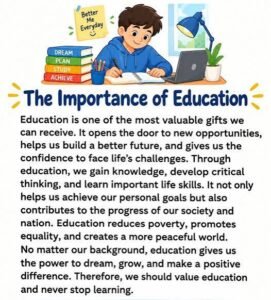 ost powerful instruments for transforming individuals, strengthening communities, and developing nations. It is the foundation upon which every successful society is built. No nation can achieve sustainable growth, peace, technological advancement, or economic prosperity without investing in the education of its people. Education is not merely about attending school, passing examinations, obtaining certificates, or acquiring academic qualifications; it is about developing the mind, shaping character, discovering talents, building confidence, and equipping individuals with the knowledge and skills needed to contribute meaningfully to society. It is the light that guides people out of ignorance and opens their eyes to opportunities, possibilities, and a better understanding of the world around them.
From the beginning of human civilisation, education has played a significant role in shaping societies. Every major advancement in science, medicine, technology, agriculture, politics, and economics has been made possible through the acquisition and application of knowledge. The buildings we construct, the medicines we use, the roads we travel on, the technologies that make communication easier, and the systems that govern our communities are all products of human learning and intellectual development. This demonstrates that education is not just an individual achievement but a collective investment in the future of humanity. A society that values education creates opportunities for its people to think critically, solve problems, make informed decisions, and build a future that benefits generations yet unborn.
1. Education Promotes Individual Development
One of the greatest importance of education in society is its ability to develop individuals intellectually, socially, emotionally, and morally. Education helps people discover their abilities, understand their environment, recognise their potential, and develop the confidence to pursue their dreams. It teaches individuals how to communicate effectively, analyse situations, make rational decisions, and approach challenges with a positive and constructive mindset.
An educated person is better equipped to understand opportunities and make informed choices about life. Education exposes individuals to different ideas, cultures, beliefs, and perspectives, helping them develop tolerance, understanding, and respect for others. It also encourages curiosity and lifelong learning, which are essential qualities in a world that continues to change.
Furthermore, education helps individuals become independent thinkers rather than people who blindly follow opinions or misinformation. It empowers them to question harmful practices, challenge injustice, and stand up for what is right. In this sense, education does not only prepare people to earn a living; it prepares them to live meaningful and responsible lives.
2. Education Reduces Poverty and Promotes Economic Growth
Education is one of the most effective tools for reducing poverty and improving the economic condition of individuals and families. When people acquire quality education, they increase their chances of gaining employment, developing professional skills, starting businesses, and participating productively in economic activities.
A person who receives education is more likely to understand financial management, business development, investment, and the importance of planning for the future. Through education, individuals can acquire the skills required to become teachers, doctors, engineers, lawyers, entrepreneurs, scientists, farmers, and professionals in various fields.
At the national level, an educated population contributes to economic development by increasing productivity, encouraging innovation, improving industries, and creating employment opportunities. Businesses and organisations need knowledgeable and skilled individuals to operate effectively and compete in an increasingly globalised economy.
Poverty often thrives where ignorance, limited opportunities, and lack of essential skills are widespread. Education helps break this cycle by giving individuals the opportunity to improve their living conditions and provide better opportunities for their children. Therefore, investing in education is not a waste of resources; it is an investment in human capital and long-term national prosperity.
3. Education Promotes National Development
No country can develop successfully without an educated population. National development goes beyond constructing roads, bridges, hospitals, schools, and government buildings. True development also requires people who possess the knowledge, creativity, discipline, and technical abilities needed to manage institutions and sustain progress.
Education provides the foundation for producing competent leaders, responsible citizens, skilled workers, researchers, and professionals who contribute to national growth. A country with a strong educational system is better positioned to address its economic, political, social, and technological challenges.
For instance, the health sector depends on educated doctors, nurses, pharmacists, and medical researchers. The agricultural sector requires trained farmers, agricultural scientists, and specialists who can introduce modern farming techniques. Similarly, the engineering and technology sectors depend on individuals with the technical knowledge needed to develop infrastructure and create innovative solutions.
In Nigeria and other developing countries, education is particularly important because it can help address challenges such as unemployment, insecurity, poverty, corruption, and inadequate technological development. When citizens receive quality education, they become better equipped to participate in national development and contribute to building a more productive and prosperous country.
4. Education Promotes Peace, Unity, and Social Stability
Education plays a significant role in promoting peace, unity, tolerance, and peaceful coexistence among people from different backgrounds. Society consists of individuals with different ethnic groups, religions, cultures, languages, beliefs, and political opinions. Without understanding and mutual respect, these differences can create misunderstanding, discrimination, conflict, and division.
Through education, people learn the importance of respecting diversity, accepting different perspectives, and resolving disagreements through dialogue rather than violence. They also gain a better understanding of human rights, justice, equality, democracy, and their responsibilities as members of society.
An educated individual is more likely to understand the dangers of prejudice, hatred, extremism, and discrimination. Education encourages people to look beyond their differences and recognise the common values that unite humanity.
In a country like Nigeria, where cultural, religious, and ethnic diversity is part of everyday life, education can serve as a powerful instrument for national integration. Schools and educational institutions can bring people together, encourage friendship, promote mutual understanding, and teach young people that peaceful coexistence is essential for national progress.
A society where people understand one another is more likely to experience peace, stability, and sustainable development.
5. Education Reduces Crime and Social Vices
Another important contribution of education to society is its ability to discourage criminal behaviour and reduce certain social problems. Although education alone cannot eliminate crime, it can help address some of the conditions that contribute to criminal activities.
Lack of educational opportunities, unemployment, poverty, poor social awareness, and limited access to positive opportunities can expose individuals, particularly young people, to harmful influences. Education provides people with knowledge, direction, practical skills, and opportunities to pursue legitimate means of achieving their goals.
Through moral instruction, civic education, and character development, students learn the importance of honesty, discipline, respect, responsibility, accountability, and obedience to lawful authority.
Education also helps people understand the consequences of drug abuse, cultism, human trafficking, examination malpractice, cybercrime, violence, and other harmful activities. It encourages young people to make responsible decisions and recognise that success should be achieved through hard work, integrity, and legitimate opportunities.
A society that educates its citizens gives them more reasons to contribute positively rather than engage in activities that destroy lives and threaten social stability.
6. Education Promotes Gender Equality and Empowers Women
Education is essential for achieving gender equality and empowering women and girls. For many years, girls and women in different parts of the world have faced discrimination, cultural restrictions, financial difficulties, and limited access to educational opportunities.
When girls are denied education, society loses the contributions, talents, intelligence, and leadership abilities they could have offered. Educating girls is not simply a matter of individual rights; it is also an important strategy for improving families, communities, and entire nations.
An educated woman is better positioned to make informed decisions about her health, career, finances, family, and future. She can participate in leadership, contribute to economic activities, establish businesses, and become a positive influence in her community.
Furthermore, educated mothers often recognise the importance of providing educational opportunities for their children, helping to create a cycle of learning and development that continues across generations.
Society must therefore reject the belief that education is more important for boys than girls. Every child, regardless of gender, deserves equal access to quality education and the opportunity to fulfil their potential.
7. Education Encourages Scientific and Technological Advancement
We live in a rapidly changing world where science and technology influence almost every aspect of human existence. From artificial intelligence and medical discoveries to digital communication, transportation, manufacturing, and space exploration, education remains at the centre of technological advancement.
Scientific discoveries do not happen by accident. They are the results of curiosity, research, experimentation, critical thinking, and the continuous pursuit of knowledge. Educational institutions provide the environment where individuals develop the skills needed to explore new ideas, conduct research, and create solutions to complex problems.
For example, medical education helps produce professionals who develop treatments, prevent diseases, and improve healthcare delivery. Engineering education contributes to the construction of safer buildings, better transportation systems, and improved infrastructure. Computer science and technological education equip people with the abilities needed to develop software, improve digital systems, and respond to modern challenges.
In today’s world, nations that invest in science, technology, engineering, and mathematics are better positioned to compete globally. Therefore, society must encourage research, creativity, innovation, and practical learning rather than focusing exclusively on examination results and certificates.
8. Education Strengthens Democracy and Good Governance
Education is essential for the survival and success of democracy. A democratic society requires citizens who understand their rights, responsibilities, freedoms, and the importance of participating in public affairs.
An educated citizen is better equipped to evaluate political information, understand government policies, question poor leadership, and make informed decisions during elections. Education also helps people recognise the importance of accountability, transparency, justice, fairness, and the rule of law.
Without education, citizens may become more vulnerable to political manipulation, false information, propaganda, and exploitation. They may struggle to distinguish between genuine leadership and empty promises.
Education empowers people to demand accountability from those in positions of authority and encourages them to participate actively in building a society where justice and fairness are respected.
For developing democracies such as Nigeria, civic and political education is particularly important. Citizens must understand that national development is not solely the responsibility of government officials. Every individual has a role to play in promoting good governance, protecting public resources, obeying the law, and contributing to the common good.
9. Education Improves Health and Quality of Life
Education has a strong connection with public health and the general well-being of society. People who receive quality education are often better equipped to understand health information, recognise potential health risks, and make informed decisions about their lifestyles.
Through education, individuals learn about personal hygiene, proper nutrition, disease prevention, environmental cleanliness, reproductive health, and the importance of seeking medical attention when necessary.
Health education also helps communities understand the dangers of harmful practices, misinformation, unsafe environmental conditions, and preventable diseases.
For example, an educated community is more likely to appreciate the importance of immunisation, clean drinking water, sanitation, regular medical check-ups, and healthy eating habits.
Education also produces the medical professionals, researchers, public health specialists, and healthcare administrators needed to improve healthcare systems.
A healthy society is a productive society, and education helps establish the knowledge and awareness necessary to protect human life and improve the overall quality of living.
10. Education Develops Moral Values and Responsible Citizenship
Education should not be measured only by academic qualifications or professional achievements. A truly educated society must also produce individuals who possess good character, moral values, and a strong sense of responsibility.
Knowledge without integrity can become dangerous when it is used for selfish purposes, exploitation, corruption, or the manipulation of others. Therefore, education must go beyond intellectual development and include character formation.
Schools, families, religious institutions, and communities all have important roles to play in teaching values such as honesty, kindness, respect, patience, humility, fairness, hard work, and compassion.
Responsible citizenship involves understanding that individual actions have consequences for the wider society. It means respecting other people’s rights, protecting public property, obeying legitimate laws, helping vulnerable people, and contributing positively to the community.
When education is combined with strong moral values, it produces individuals who are not only intelligent but also responsible, trustworthy, and committed to the welfare of others.
11. Education Prepares the Younger Generation for the Future
Children and young people represent the future of every society. The quality of education they receive today will significantly influence the kind of nation that exists tomorrow.
Education prepares young people to face the challenges of adulthood by equipping them with knowledge, practical skills, confidence, discipline, and the ability to adapt to changing circumstances.
The modern world is constantly evolving. Many careers that exist today may change significantly in the coming years, while entirely new professions may emerge. Therefore, young people need more than the ability to memorise information. They need creativity, communication skills, critical thinking, digital literacy, problem-solving abilities, and a willingness to learn throughout their lives.
Educational institutions must prepare students for real-life situations by combining theoretical knowledge with practical experience. Entrepreneurship, financial literacy, vocational training, leadership development, and technological skills should receive greater attention.
The goal of education should not simply be to produce graduates who are searching for employment. It should also produce innovators, employers, researchers, creative thinkers, and problem-solvers who can create opportunities for themselves and others.
12. Education Promotes Social Equality and Equal Opportunities
One of the greatest promises of education is that it can provide individuals from different social and economic backgrounds with opportunities to improve their lives.
A child born into a poor family should not be denied the opportunity to become a doctor, engineer, teacher, scientist, or successful entrepreneur simply because of their financial circumstances. Quality education can help bridge the gap between the privileged and the disadvantaged by providing people with the knowledge and skills required to pursue their ambitions.
However, this promise can only become a reality when education is accessible, affordable, inclusive, and of good quality.
Governments must therefore invest in public schools, provide adequate learning facilities, support disadvantaged students, train qualified teachers, and ensure that children with disabilities are not excluded from educational opportunities.
When every individual has a fair opportunity to learn and develop, society benefits from a wider range of talents, abilities, and ideas.
13. The Responsibility of Government and Society in Promoting Education
Although education is important to everyone, its success requires the collective commitment of governments, parents, teachers, private organisations, communities, and individuals.
Governments must recognise education as a fundamental investment rather than an unnecessary financial burden. They should provide adequate funding, build and maintain schools, employ qualified teachers, improve learning facilities, develop relevant curricula, and ensure that educational policies are properly implemented.
Teachers must also be recognised and respected because they play a major role in shaping the minds and characters of future generations. They deserve proper training, reasonable working conditions, professional development, and adequate compensation.
Parents have the responsibility to encourage their children to learn, provide guidance, monitor their academic progress, and create an environment that supports education.
Private organisations and community leaders can contribute through scholarships, educational programmes, vocational training, mentorship, and the provision of learning materials.
Most importantly, students must understand that education requires commitment, discipline, patience, and hard work. Opportunities may be provided, but individuals must be willing to make use of them.
Conclusion: Education Is the Key to a Better Society
In conclusion, education is much more than a pathway to obtaining certificates or securing employment. It is the foundation of individual empowerment, social transformation, economic prosperity, national development, peace, equality, and sustainable progress. It gives people the ability to understand their world, challenge limitations, discover opportunities, and contribute meaningfully to humanity.
A society that neglects education risks creating generations that are poorly equipped to address the challenges of their time. On the other hand, a society that prioritises education invests in knowledge, innovation, leadership, creativity, and the future of its people.
We must understand that the classroom is not merely a place where students sit to receive instructions; it is a place where future leaders are shaped, great ideas are developed, problems are solved, and destinies are transformed. Every teacher who educates a child, every parent who sacrifices to send a child to school, every government that invests in learning, and every student who remains committed to acquiring knowledge contributes to the development of society.
Education should never be regarded as a privilege reserved for the wealthy or the powerful. It is a fundamental human right and a powerful instrument that should be accessible to everyone, regardless of age, gender, religion, ethnicity, disability, or financial background.
We must also remember that the true value of education is not determined by the number of certificates a person possesses but by how effectively that knowledge is applied to improve lives and solve problems. A person may acquire several academic qualifications and still fail to contribute positively to society if that knowledge is not accompanied by wisdom, integrity, and responsibility.
The future of every nation is not determined only by the wealth of its natural resources, the strength of its military, or the number of its industries, but also by the quality of education available to its people. A nation that educates its citizens gives itself the opportunity to overcome ignorance, defeat poverty, promote justice, encourage innovation, and build a sustainable future.
Therefore, if we desire a society characterised by peace, equality, progress, prosperity, and responsible leadership, we must make education a priority. We must invest in schools, support teachers, encourage lifelong learning, empower young people, and ensure that no child is denied the opportunity to learn.
Let us never forget that when we educate one person, we empower an individual; when we educate a generation, we transform a society; and when we make education a priority, we build a future that generations will be proud to inherit.
Education is not simply the preparation for life; it is one of the greatest forces that makes a better life and a better society possible. It is the foundation of progress, the weapon against ignorance, the bridge to opportunity, and the light that guides humanity towards a brighter future.
A society that invests in education today does not have to struggle to build a better tomorrow.